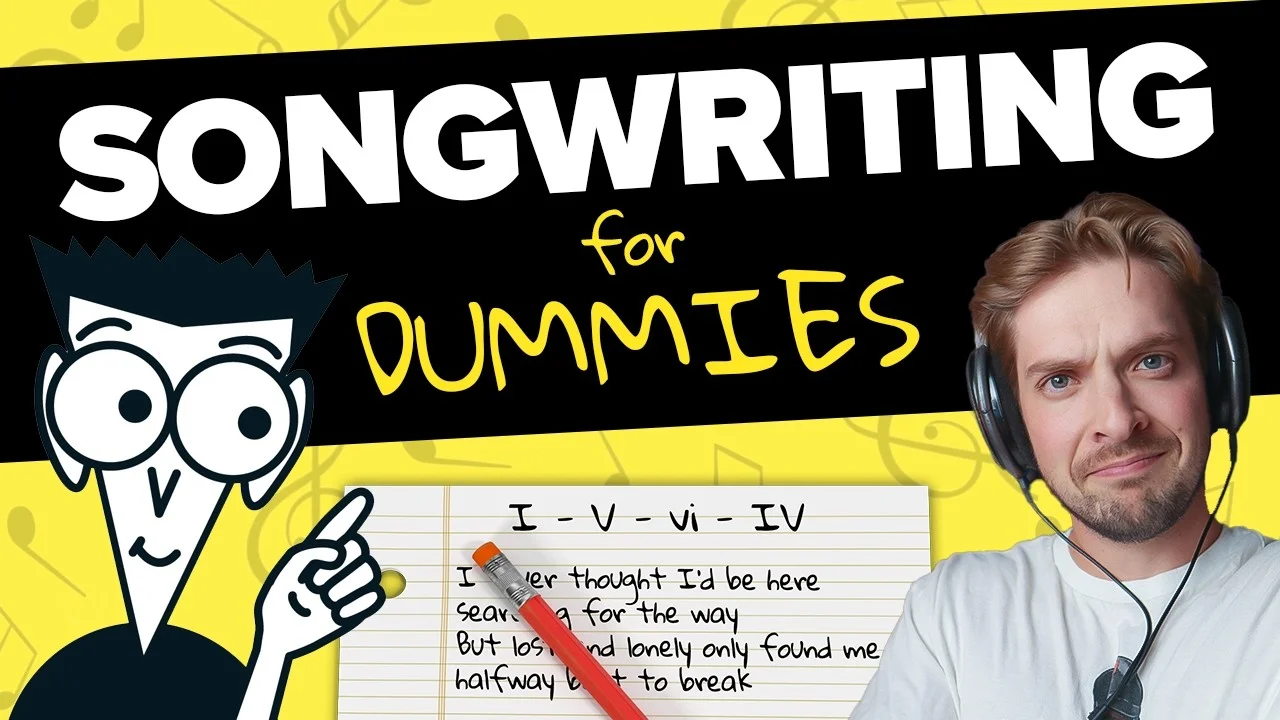
How to Write a Song: Songwriting for Dummies
Songwriting is hard, and most beginners get it wrong. But that's why I'm here. In this video, I'm going to break down the methods I use to write amazing songs.

Key Takeaways
- Start with chords first to create the harmonic foundation everything else builds on
- Break songwriting into four steps: chords, arrangement, melody, then lyrics
- Keep syllable counts similar between lines to make your song flow smoothly
- Use verse-chorus contrast by changing chords and melody between sections
- Trust your ear and don't wait for perfection on your first song
Writing a song feels impossible when you’re staring at a blank page.
There’s a mountain of moving parts — chords, melody, lyrics, arrangement — and most beginners get overwhelmed trying to tackle everything at once. But here’s the thing: songwriting doesn’t have to be complicated.
I’m going to break down my exact method for writing songs into four simple steps. By the end of this post, you’ll have a clear roadmap for creating your own music, even if you’ve never written a song before.
I also made a full video on this…
All the ideas in this article come from the video below. If you don't feel like reading, well, I gotchu.
The Essential Building Blocks You Need to Know
Before we dive into the method, let’s cover the four core concepts that make up every song:
Music Theory — How musical notes work together to create harmony. Don’t worry, we’re keeping this simple.
Song Arrangement — How your song flows from section to section (verse to chorus to bridge, etc.).
Melody — The pitch of the main vocal line that carries your lyrics.
Lyrics — The words that tell your story.
These might sound intimidating, but I promise they’ll make perfect sense once we start building our song step by step.
One quick note: having an instrument helps, but it’s not required. If you don’t play anything, you can follow along by programming basic chords into your DAW and playing them back. The important thing is getting started.
Step 1: Choose Your Chords
Nine times out of ten, I start with chords.
You could begin with lyrics or melody, but chords give you the harmonic foundation that everything else sits on top of. Think of them as the skeleton of your song.
Your 60-Second Music Theory Crash Course
To choose chords that actually sound good together, we need to understand keys.
Let’s work in C major — the easiest key because it uses only the white keys on a piano. The C major scale contains these notes: C, D, E, F, G, A, B, and back to C.
The magic happens in the relationships between notes. The distance from C to D is called a whole step (covering two semitones). The distance from E to F is a half step (one semitone).
The pattern for any major scale is: whole, whole, half, whole, whole, whole, half.
You can use this pattern starting on any note. If you start on G, you get: G, A, B, C, D, E, F#, G. But let’s stick with C major for simplicity.
Building Your Chord Palette
Here’s where it gets practical. We can turn each note of the C major scale into a chord and number them:
- I (1) = C major
- ii (2) = D minor
- iii (3) = E minor
- IV (4) = F major
- V (5) = G major
- vi (6) = A minor
- vii° (7) = B diminished
Notice the pattern: I, IV, and V are major chords (capitalized Roman numerals), while ii, iii, and vi are minor chords (lowercase Roman numerals).
This gives you seven chords to choose from: C major, D minor, E minor, F major, G major, A minor, and B diminished.
The beauty? All these chords work together because they’re built from the same scale. You can mix and match them however you want, and they’ll sound cohesive.
Start experimenting. Play around with different combinations until something catches your ear. There are no wrong answers here — just different moods and feelings.
Step 2: Arrange Your Song Structure
Songs aren’t just one long chord progression. They change and evolve — from a mellow verse to an energetic chorus and back again.
Song arrangement is how you organize these different sections to create emotional peaks and valleys.
Keep It Simple: Verse, Pre-Chorus, Chorus
For this example, let’s use a straightforward structure:
- Verse (8 bars)
- Pre-Chorus (8 bars)
- Chorus (8 bars)
Normally you’d add a second verse, pre-chorus, and chorus, plus maybe a bridge. But this basic structure is perfect for getting started.
Creating Contrast Between Sections
Here’s a key principle: each section should feel different from the others.
You can achieve this by changing up the chords between sections. It’s not mandatory — some great songs use the same progression throughout — but contrast keeps things interesting.
Let me show you how I approached each section:
Verse progression: I started with C major (our I chord), moved to A minor (vi chord) for a sadder feeling, then to F major (IV chord) for resolution.
Pre-Chorus: I used different chords entirely to create a sense of movement and build-up toward the chorus.
Chorus: This needed to feel like the emotional peak, so I chose chords that felt more open and powerful.
Play around with the rhythm too. You can hold some chords longer, others shorter. Experiment until you find something that feels right.
The key is trusting your ear. If it sounds good to you, it probably is good.
Step 3: Choose Your Melody
Now that you have chord progressions for each section, it’s time to add melody over the top.
My favorite technique? Humming and scatting.
The Humming Method
Put your chord progression on loop and start humming along. Don’t overthink it — just let your voice wander until you find something that feels good.
You can either:
- Play your instrument and hum simultaneously
- Record yourself playing the chords, then hum over the playback
Both work perfectly. The goal is finding a vocal line that complements your chord changes.
Creating Melodic Contrast
Just like with chords, each section should have its own melodic character:
- Verse: Keep it lower and softer in your vocal range. This creates intimacy and draws listeners in.
- Pre-Chorus: Start building energy. Maybe climb a bit higher.
- Chorus: This is your peak. Use the upper part of your range to create excitement and release.
The melody you create during this step is just a guideline, not set in stone. Once you start adding lyrics in the next step, you might need to adjust things. That’s totally normal.
What matters is having a rough outline to build from.
Step 4: Write Your Lyrics
You’ve got chords. You’ve got a melody outline. Now it’s time to write lyrics that turn your musical sketch into an actual song.
Lyrics can be the trickiest part, but like everything else in music, the more you practice, the easier it gets.
Start With Brainstorming
Before writing any actual lines, brainstorm words and concepts that match the mood of your music.
Listen to your chord progression and melody. What emotion do they evoke? A sad-sounding track deserves melancholy lyrics. An upbeat progression calls for positive messaging.
For my example song, the chords felt somewhere between sad and hopeful — perfect for a space-themed love song about distance and longing.
I brainstormed words like: space, stars, planets, telescope, satellite, gravity, distance, moon, orbit, atmosphere.
Don’t filter yourself during brainstorming. Write down every word that comes to mind. You can refine later.
Understanding Rhyme Schemes
Good lyrics usually rhyme, and rhyming creates emotional connection between lines.
Here are two simple rhyme schemes to start with:
AABB: The first two lines rhyme with each other, and the last two lines rhyme with each other.
- Line 1 (A): “Watching all the stars tonight”
- Line 2 (A): “Everything will be alright”
- Line 3 (B): “You’ve been distant, you’ve been cold”
- Line 4 (B): “Stories that were never told”
ABAB: Lines 1 and 3 rhyme, lines 2 and 4 rhyme.
- Line 1 (A): “Watching stars up in the sky”
- Line 2 (B): “You’ve been distant, you’ve been cold”
- Line 3 (A): “Wondering if you’ll say goodbye”
- Line 4 (B): “Stories that were never told”
Stick with these patterns when starting out. You can experiment with more complex schemes later.
The Syllable Secret
Here’s something most beginners miss: syllable count matters.
A syllable is each distinct sound in a word. “Water” has two syllables (wa-ter). “Sun” has one.
Lines that have similar syllable counts flow better together. If your first line has 8 syllables, try to keep your other lines close to that number.
This is one of the biggest mistakes I see in beginner songwriters. When syllable counts are all over the place, songs feel choppy and disconnected.
Verse vs. Chorus Approach
Verses tell specific stories. They paint pictures and set scenes. Think of them as the detailed narrative parts of your song.
Choruses express universal emotions. They’re the parts people sing along to because they capture feelings everyone can relate to.
For my space-themed song:
- Verse: “Watching all the stars on the hillside from our car / But I don’t need a telescope to see your heart’s grown cold”
- Chorus: “I’d give you the moon if it would make it alright / I’d give you Mars when it comes by”
Notice how the verse sets a specific scene (watching stars from a car), while the chorus expresses the universal desire to do anything for someone you love.
Putting It All Together
Start with your brainstormed words and fit them into your melody. Don’t worry about perfection on the first pass.
For my example, I used the space theme throughout:
- Telescope, stars, planets, satellite
- Distance, space, gravity
- Moon, Mars, orbit
The story became about someone emotionally distant (“your head’s in space”) and the singer’s willingness to give them the universe to bring them back.
Remember: lyrics should serve the melody, not fight against it. If a word doesn’t fit naturally, change the word or adjust the melody slightly.
The Final Product
After working through all four steps, here’s what we created:
Watching all the stars on the hillside from our car
But I don’t need a telescope to see your heart’s out in the cold
Lately you’ve been distant, you’ve been walking
Your head’s in space and you won’t listen
On a different planet, you’ve been walking
I know this isn’t what I wanted
I’d give you the moon if it would make it alright
And I’d give you Mars when it comes by
When you get far away like a satellite
I’ll let gravity bring you back to mine
Notice how every element we discussed comes together:
- Chords: All from the C major scale, creating harmonic consistency
- Structure: Clear verse and chorus sections with distinct feelings
- Melody: Lower for the verse, higher and more energetic for the chorus
- Lyrics: Space theme throughout, with ABAB rhyme scheme and consistent syllable counts
Your Next Steps
Writing one song is just the beginning.
Go back and rework what you’ve created until it feels exactly right. Add a bridge. Write a second verse. Experiment with the arrangement.
Then write another song. And another.
The more you repeat this process, the less you’ll have to think about it. Eventually, these steps become second nature, and you can focus purely on the creative side.
The method I’ve shown you works because it breaks down an overwhelming task into manageable pieces. You’re not trying to solve everything at once — just one step at a time.
Chords first. Then arrangement. Then melody. Finally lyrics.
Master this approach, and you’ll never stare at a blank page wondering where to start again.
Start with simple progressions in familiar keys. Keep your arrangements basic. Trust your ear for melody. Let your lyrics tell stories that matter to you.
Most importantly — don’t wait for perfection. Your first song won’t be your best song, and that’s perfectly fine. Every songwriter starts somewhere.
The magic happens when you stop overthinking and start creating.
Want the full walkthrough? My course Pro Vocals in 60 Minutes takes you from raw recording to polished vocal, step by step.
About Mattie
Mattie is a music producer, songwriter, and educator specializing in Logic Pro and vocal production. With over 10 years of experience in the music industry, he's helped thousands of artists transform their home studio recordings into professional-quality tracks.
As the founder of Music By Mattie, he creates tutorials, presets, and courses that simplify complex production techniques. His mission is to make professional music production accessible to everyone, regardless of budget or experience level.