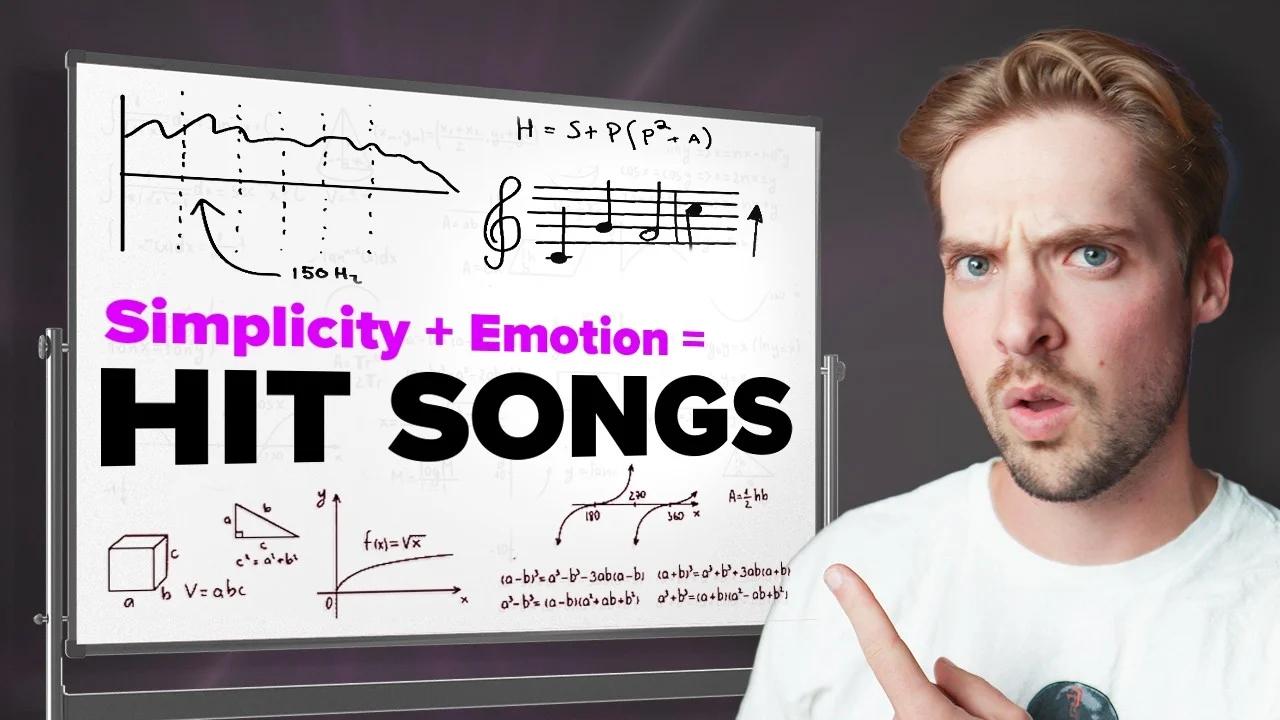
The Scienitific Way to Make Hit Songs
Apparently, science can predict hit songs. But what's the secret formula they're using to do so? Is it a good hook? Is it a simple chord structure? Is it voodoo

Key Takeaways
- Pop genre has the widest international appeal, while hip-hop dominates US charts specifically.
- Spotify's hidden metrics like danceability and valence predict hits with 88% accuracy.
- The verse-verse-chorus-verse-chorus-bridge structure mirrors how human attention naturally works.
- Simple melodies paired with complex production consistently outperform overly complicated songwriting.
- Repetitive lyrics with personal pronouns increase processing fluency and chart success.
I’ve always wondered why some songs explode across the charts while others disappear faster than yesterday’s TikTok trends.
Turns out there’s actual science behind it — not vibes, not luck, but a formula that makes people hit repeat over and over again. I dove into a mountain of research studies and analyzed over a million songs from 1950 to today, all while creating my own track to test these theories.
What I discovered might change how you approach songwriting forever.
I also made a full video on this…
All the ideas in this article come from the video below. If you don't feel like reading, well, I gotchu.
Part of the Songwriting series — For the full picture, read my complete songwriting guide.
The Problem That Started Everything
I was scrolling online when an article completely blew my mind. Apparently, researchers from Stanford built an algorithm that could correctly predict Billboard hits 75% of the time.
That seemed pretty high, right? Most of the music I personally love is way different than what’s trending on the Billboard Hot 100.
But then I found another study that made my jaw drop even more — this algorithm could predict songs with 88% accuracy. That’s 33% higher than the Stanford research.
If this is true, what patterns are these algorithms finding that separate hits from everything else?
Testing My Own Hit-Prediction Skills
Before diving deeper, I needed to check if 88% accuracy was actually as impressive as it sounded.
So I challenged myself with a quiz. I had ChatGPT generate 80 popular songs from the last 50 years, and I tried guessing whether they made the Billboard Hot 100 or not.
Going into it, I felt confident. I’m a professional music producer — surely I’d score around 70-80%, right?
I got 36 out of 80 correct.
That’s 45%. Absolutely terrible.
But here’s the thing — research shows I’m not alone in being awful at predicting hits:
- Studies on the entertainment industry found people guess movie success correctly about 50% of the time
- Research by Robert Prey concluded that people are generally bad at predicting hits
- Even functional MRI studies trying to predict hit songs got it right less than 50% of the time
We’re terrible at predicting what will be successful, but algorithms apparently aren’t.
There had to be something these algorithms were seeing that I was missing completely.
Act 1: Choosing the Right Genre
If I was going to build a song using scientific principles, I needed to start with the most fundamental question: What genre should I write?
According to research from Headphones Addict, pop is the most popular music genre worldwide. That makes sense — “pop” is literally short for “popular music.”
Hip-hop and R&B dominate the US market specifically. Since I’m in the US, maybe that would give a hip-hop track the best shot at charting.
But I’m a pop music producer at heart, and pop has that international appeal. Even though the data suggested hip-hop for the US market, I decided to stick with what I know best.
Genre decision: Pop it is.
Act 2: Cracking the Beat Code
With genre locked down, I needed to figure out what kind of beat would give my song the best shot at success.
I found an incredible dataset on Kaggle with hundreds of Billboard Hot 100 hits and all their Spotify analytics. I had no idea Spotify tracked this much data when you upload songs, but apparently they measure:
- Danceability
- Energy
- Speechiness
- Acousticness
- Liveness
- Instrumentalness
- Valence
Here’s the crazy part — that 88% accuracy study I mentioned earlier? It used these exact Spotify metrics in its algorithm.
Maybe understanding what each of these numbers really means would help crack the code.
Decoding Spotify’s Secret Metrics
Let me break down what Spotify actually measures with each metric:
Danceability refers to how easy it is to dance to the song. Spotify measures tempo, beat strength, and rhythm consistency.
Energy is how calm or exciting a track feels. It looks at general loudness, the timbre of instruments, and entropy (basically how much chaos is happening).
Speechiness covers how much talking versus singing is in the track. Podcasts score close to 1.0, rap songs are more “speechy” than ballads.
Valence shows how happy or sad a song is, measured through lyrical content, major/minor chords, and instrument types. Interestingly, looking at the chart, tons of both happy AND sad songs make the Billboard Hot 100.
Acousticness measures how raw the song is. Think coffee shop acoustic guitar performance (high acoustic) versus heavily produced pop track (low acoustic). Most hits lean toward higher production value.
Popularity uses play counts and recency to rank songs — great for predicting hits but useless for making them.
Finding the Sweet Spot
I averaged all these metrics from the 600 Billboard hits in my dataset, but I wanted more data. I found another study with different Billboard hit analysis and combined their findings with mine.
This gave me target ranges for each metric, which I then matched to actual reference songs:
For valence (happiness/sadness): “Hey Mama” by David Guetta or “I Don’t Give A” by Dua Lipa
For energy: “Say So” by Doja Cat or “Flowers” by Miley Cyrus
For danceability: “Starboy” by The Weeknd or “Since U Been Gone” by Kelly Clarkson
For acousticness: “Thank U, Next” by Ariana Grande or “Take a Bow” by Rihanna
For speechiness: “Juice” by Lizzo or “Run It!” by Chris Brown
Normally I only use 2-3 reference songs max. This was like 12 references — but having specific targets for each metric was actually incredibly helpful for crafting the beat.
Act 3: The Science of Song Structure
Once I had my beat foundation, I needed to figure out the optimal song structure. Should I start with a verse? Jump straight into the chorus? Do I even need a bridge?
Science had some fascinating answers.
The Psychology of Musical Surprise
One study analyzed 880,000 chords across 745 classic US Billboard pop songs and found that musical pleasure comes from the right combination of uncertainty and surprise.
The study revealed two key principles:
- When people hear simple chord progressions and an unexpected chord happens, they prefer it
- When they hear complex progressions and something predictable occurs, they also enjoy that
The sweet spot is balancing predictability with surprise.
The Rat Experiment That Changed Everything
Dr. David Huron conducted an incredible experiment using musical sounds with rats to study expectation and psychology.
He started by playing a single note — A. The rats turned their heads toward the sound.
Then he played A-A. The rats turned their heads both times.
But when he played A-A-A, something interesting happened. On the third A, the rats stopped caring. They didn’t turn their heads — they just weren’t interested anymore.
However, when he changed the pattern to A-A-B, the rats maintained their attention for all three sounds.
Dr. Huron continued experimenting to find the shortest pattern that could continuously keep the rats’ attention. He discovered: A-A-B-A-B-C.
Here’s the incredible part — if we replace A with “verse,” B with “chorus,” and C with “bridge,” we get: Verse-Verse-Chorus-Verse-Chorus-Bridge.
This happens to be one of the most popular song structures in modern music, and apparently it’s based on fundamental psychology of attention and expectation.
I structured my song exactly according to this pattern.
Act 4: The Melody Formula
With structure locked down, I needed to tackle one of the most crucial elements: the melody.
Melody Beats Lyrics (Science Says So)
I found a study comparing the impact of lyrics versus melodies on emotional response. Melodies are actually more important than lyrics for conveying emotion.
I’ve been preaching this for years, so it felt amazing to have scientific backing.
The Simplicity Trend
Another study revealed that melodies have become less complex and simpler over time.
Why? The research suggests it’s because other song elements have increased in complexity:
- Faster tempos
- More vocal layers
- Higher production quality
- Increased overall complexity in timbre
Ever since we transitioned from analog to digital, these production tools became way more accessible. As production got more complex, melodies got simpler to balance things out.
I kept this principle in mind while crafting multiple melody ideas, making sure each one was memorable but not overly complex.
Act 5: The Lyrics Science
Even with a solid melody, I still needed to nail the lyrics if my song had any shot at success.
The Evolution of Lyrics
Research shows that lyrics have become simpler and less complex over time — just like melodies. But there’s more:
- Lyrics have become more angry over time (interesting trend)
- Sad lyrics make sad songs even sadder, but lyrics on happy songs don’t necessarily make them happier
- Modern lyrics use more personal pronouns like “I” and “me” than ever before
- Words related to positive emotions like “love” are being used less frequently
The Power of Repetition
A study from the Journal of Consumer Psychology revealed something crucial: repetitive lyrics increase processing fluency and drive market success.
Another study showed that songs with higher rhyme saturation and basic readability not only reach higher chart positions but resonate more deeply with listeners.
The formula became clear:
- Keep lyrics simple
- Include lots of rhyming
- Repeat key phrases frequently
- Use personal pronouns
- Slight negative emotional lean
Writing Within the Framework
I started by brainstorming a word palette that fit these scientific guidelines — simple words, slightly angry tone, personal pronouns, high repeatability.
Then came the hard part: fitting these concepts into my pre-existing melody while maintaining the right syllable count and making sure the song hit those target Spotify metrics for danceability.
It took hours of refinement, but nailing the lyrics was essential if this scientific approach was going to work.
Act 6: The Final Product
After days of research, analysis, and production work following every scientific principle I could find, here’s what I created:
*“Still got a reason, she left in my room
Now she just history and I’m old news
We had a problem, fell out of love
Weeks apart, she’s calling me up
And I’m not sure if I’ll pick up
Is it a waste of time if you came to stay the night?
Fall asleep with me right by your side, by your side
Tell me is it worth the risk?
Will it hurt to make it worse again?
Should we turn away what we did?
With one last night and one more…“*
The track incorporated everything the studies suggested:
- Simple, repetitive melody that’s easy to remember
- Clear verse-verse-chorus-verse-chorus-bridge structure based on the rat attention study
- Personal pronouns throughout (“I,” “me,” “you”)
- Slight negative emotional valence (breakup theme)
- High rhyme saturation and repetitive phrases
- Production values that hit the target Spotify metrics
The Formula Revealed
So was I able to find the secret formula that separates hits from mediocre songs?
Kind of.
Here’s what the science reveals about Billboard hits:
The Simplicity Principle
The majority of hit songs are built on simple foundations — simple melodies, simple lyrics, simple core ideas. Complexity comes from production, not from the fundamental song elements.
The Surprise-Predictability Balance
Hits use unpredictability and predictability strategically to hook listeners. They establish patterns, then break them at just the right moments to maintain attention.
The Repetition Rule
Successful songs use repeated patterns everywhere — in melodies, song structure, drum grooves, and especially lyrics. Repetition increases processing fluency and makes songs more memorable.
The Emotional Connection
Maybe most importantly, hit songs make you feel something. The more your melody, beat, production, and lyrics work together to convey a clear emotion, the higher your likelihood of success.
Beyond the Algorithm
But here’s the thing — even with all this scientific insight, there are tons of factors the studies didn’t cover that massively impact a song’s success:
- Music marketing strategy
- Social media presence and timing
- Cultural trends and zeitgeist moments
- Playlist placements and industry connections
- Artist branding and fanbase
- Pure luck and timing
An algorithm might predict 88 out of the next 100 hits, but if you keep working hard and making music you’re passionate about, you could be one of the 12 it never saw coming.
The science gives us a framework, not a guarantee. Use these principles as guidelines, but don’t let them kill your creativity or unique voice.
At the end of the day, the best “formula” is still making music that genuinely moves people — whether that fits the algorithm or not.
Want a professional starting point? My Vocal Magic presets give you ready-made vocal chains for any genre — EQ, compression, reverb, and more, all dialed in and ready to go.
Or grab my free vocal presets to try before you buy.
About Mattie
Mattie is a music producer, songwriter, and educator specializing in Logic Pro and vocal production. With over 10 years of experience in the music industry, he's helped thousands of artists transform their home studio recordings into professional-quality tracks.
As the founder of Music By Mattie, he creates tutorials, presets, and courses that simplify complex production techniques. His mission is to make professional music production accessible to everyone, regardless of budget or experience level.