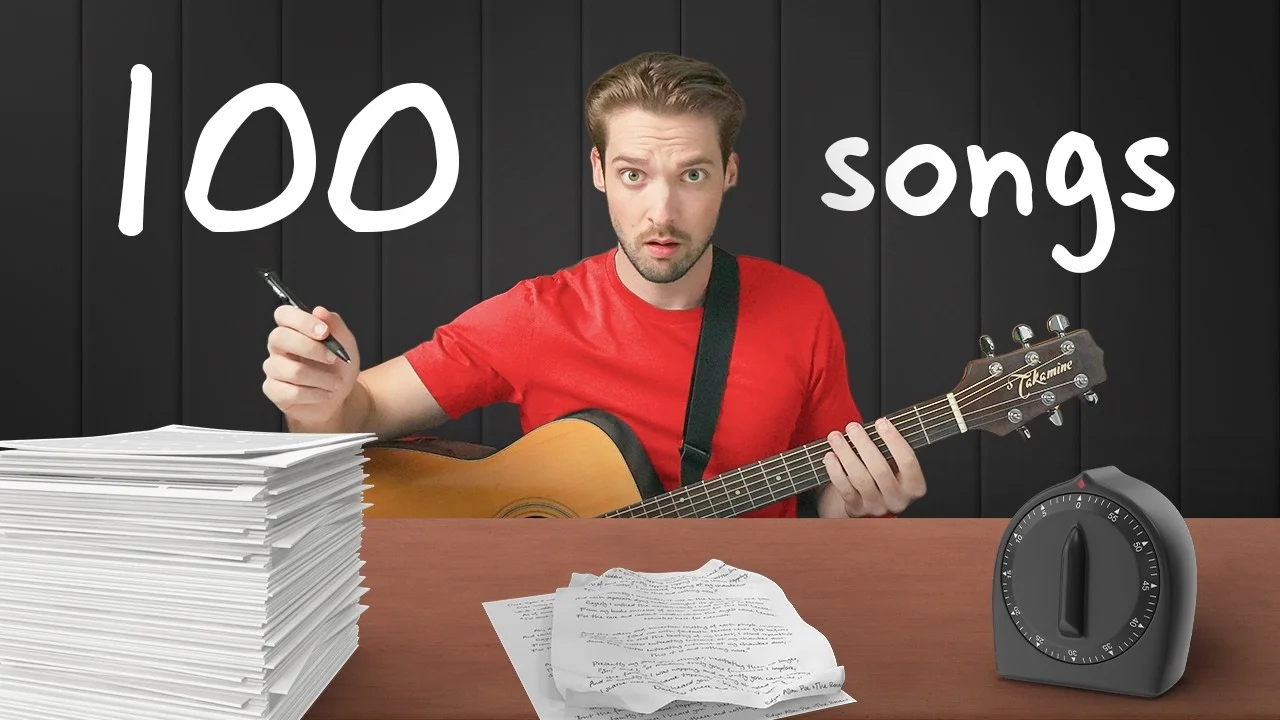
I tried writing 100 songs in 30 days
I challenged myself to write 100 songs in 30 days. Here's what happened, what I learned about creativity, and how it changed my songwriting process.

Key Takeaways
- Creative ruts only exist if you let them - action beats anxiety every time.
- Set financial stakes on your goals to force accountability when motivation fades.
- Stop chasing perfection in your creative work - it kills inspiration and freezes progress.
- Consistency beats waiting for inspiration - most breakthrough ideas come from showing up daily.
- Focus on enjoying the creative process rather than obsessing over the end result.
I’ve been in a creative rut.
My production clients stopped coming in as consistently. I moved to a city where I know almost nobody, and I didn’t feel the inspiration I once did to keep writing and making music.
But I knew that rut was only as big as I let it be. And that the only cure for the anxiety I was feeling was action.
So I set out to do something difficult to reignite my passion for creation — to inspire me once again to pursue the thing that fuels me up more than anything else in the world: making music.
I decided I was going to write 100 songs in 30 days.
It almost broke me. But it also changed the way I write music forever.
I also made a full video on this…
All the ideas in this article come from the video below. If you don't feel like reading, well, I gotchu.
Part of the Songwriting series — For the full picture, read my complete songwriting guide.
The Challenge That Started It All
Monday, March 31st officially marked day one of this challenge.
I was excited — and terrified. Three songs per day for 30 days straight. That was the math I needed to hit my goal.
Simple on paper. Brutal in reality.
But like with any goal, the easiest time to hike is when you first start the climb. The mountain never seems so tall until you’re halfway up.
And this mountain ended up being a lot taller than I thought.
Why I Chose Creative Torture
I’d be lying if I said reigniting my creativity was the only reason I wanted to attempt this challenge.
Here were my four burning questions:
Question 1: Would this get me out of my creative rut?
I was stuck. Uninspired. Living in a new city with no connections and feeling like I’d lost my spark entirely.
Question 2: Would writing 100 more songs make me a better songwriter?
I’d already written thousands of songs over the years. Would another hundred actually move the needle on my skills?
Question 3: Could I write a hit song?
The logic seemed sound — if I write 100 songs, one or two of them is bound to be really good. Right?
Question 4: Could I find my sound?
This might have been the most important question on the entire list. I’ve created music for years, but I’ve always struggled to find the music that I want to release — the music that feels the most authentic to who I am as a person.
With a solid why, I was ready to begin my journey.
The Early Days (And My Messy Workflow)
The first few days started off solidly.
I was inspired by the excitement of a new challenge, and I had a clear outline: write an average of three songs per day to hit 100 songs in 30 days.
For songwriting, I stuck to a workflow that’s worked for me for years:
- Chords first — piano, guitar, or straight into the DAW
- Brainstorm lyrical themes and hum melodies over the progression
- Record everything as voice notes or use Apple Notes to write lyrics down
It’s messy, but it worked. Mostly.
Looking back at all those songs I wrote — none of them were organized whatsoever. But the most important thing was that I recorded all of them so they didn’t get lost in the ether.
This lack of organization would turn out to be a giant pain in the ass later.
The days started to blend together and the songs came pouring out. Sometimes the ideas flowed like water. Other times this process would take hours to write even one song — which is about what I expected.
Typically, on top of all the other things I was doing in a day, writing three songs would take me anywhere from 2 to 4 hours.
The Wall (And My First Failure)
By day 10, I had written 30 songs. Everything was going according to plan.
But the excitement of the new challenge had worn off, and I was feeling like I needed a quick break.
So on day 11, I took one.
I told myself that I needed a day or two to reset and let my brain recharge its creative juices. But deep down, I knew I was just avoiding the challenge.
That one break turned into a week. Then two.
All of a sudden I had 10 days left and still needed to write 70 songs.
Thinking that was way too much to overcome, I decided to quit the challenge. I was ashamed, I was disappointed, and I was well short of my goal.
But if you thought one attempt was enough to stop me, then you thought wrong.
The Restart (With $500 on the Line)
One day, after deciding there was no way I was going to complete the initial challenge, I decided to restart it.
Part of me dreaded spending more time in my day writing songs again. But I knew I had to show up if I wanted the answers to the questions still burning in my brain.
This time, I had a trick up my sleeve that I thought would practically guarantee success.
I found this website called Beeminder that lets you wager money on goals you set for yourself. I decided to wager $500 that I would complete this challenge the second time around.
Yeah, it’s based on the honor system. I could easily cheat and lie. But just the thought of losing $500 was enough to spur me to actually do this.
And if losing $500 wasn’t enough motivation, then maybe I just shouldn’t do this challenge at all.
This was less about the money and more about the other reasons I started this journey — reigniting my spark, improving my craft, and finding my sound.
This crazy idea finally gave me a solution for the biggest variable in the challenge: me.
Round 2: Everything Changed
This attempt felt different. And not just because of the money I’d wagered.
I used what I learned from the first attempt to radically shift my approach to the entire process.
I gave up the thought of writing a hit song in the first place.
I was writing to express myself. I was writing to do the damn thing and push my creative limits.
When I shed that idea of perfectionism, the entire process changed. The first week went by and I actually enjoyed it.
But that wasn’t the only shift I had.
I also let myself be more free in the songs I wrote. Yes, I was looking for my sound, but the pressure I was putting on myself to find it only kept it more hidden.
I stopped caring about my sound and instead decided to let it find me.
Two weeks went by and I was writing:
- Irish jigs off the old town
- R&B pop ballads
- Cowboy country
- Everything in between
And I was having a blast doing it.
That is, until week three.
Week Three: The Creative Well Runs Dry
Three weeks in, I hit another speed bump. I needed a break — another day to recharge my creative batteries.
So I took it. But I wasn’t going to let this break slide into two weeks like it did the first time.
Even after my break, my brain wasn’t firing on all cylinders. But I had planned for this.
It was time to play my trick card.
Knowing that at some point during this challenge my creative well of ideas might run dry, I prepared a list of songwriting exercises I could use whenever I felt writer’s block rear its ugly head.
There were eight exercises I’d collected over the years to help guide my pen to write, and they absolutely did. (You can grab these songwriting prompts as a free download if you want to jumpstart your own songs.)
Week three came and went. Between the looming thought of losing $500, songwriting exercises to beat writer’s block, and a newfound enjoyment of writing, it flew by.
The Final Sprint
Before I knew it, there were four days left. And I was in a bit of a predicament.
It was Sunday. I had four days left in the challenge, and I had about 20 more songs to write. I’d stayed up all night with a buddy who was leaving town, and honestly? I didn’t want to write any songs.
But there were no options. I was just going to have to do it.
What’s a challenge without being challenging?
I continued working and wrote the remaining songs I needed until I found myself on the last day needing to only write two more songs.
It was officially May 23rd, 9 PM, and this challenge was almost over. I’d been diligent. I’d been working hard. I’d been writing songs like my financial life depended on it (because it did).
Earlier that morning, I’d written two songs. I had four total to write that day to complete the challenge. That meant I just needed song number 99 and song number 100, and I would have written 100 total songs in a month.
Crazy to think I’d written that many songs. The time had flown by.
But I was exhausted. Work was getting tiring. After finishing those last two songs, I knew I needed to step back and re-evaluate the whole process.
The Answers I Found
Now that it’s over, how do I feel about those questions that inspired this challenge in the first place?
Question 1: Did I Get Out of My Rut?
100% yes.
I feel night and day different creatively than I did when I started this. The spark is back.
Question 2: Did My Songwriting Get Better?
This one surprised me. I’d already written thousands of songs before this challenge. I didn’t think adding another hundred would increase my skill level.
But I found myself reaching for more complex melodies and more interesting chord progressions than I normally would.
So yeah. Yeah, I did get better.
Question 3: Did I Write Anything Worth Keeping?
Absolutely.
I tracked some interesting data about all the songs I wrote. For every song, I recorded:
- The date I wrote it
- The genre
- The method I used to record it
- A rating on a scale of 1 to 5 based on how good I thought it was
Here’s what I found:
25 of those 100 songs were fives — songs I would absolutely produce.
47 were solid fours or 4.5s.
Only 44 were a three or lower.
Now, I may be biased in these rankings, and there’s a pretty heavy skew towards fours and fives. But I think there’s an easy explanation for that.
As I’m writing songs, I don’t normally finish songs that I don’t like. If there’s something I dislike about a song during the process, I just change it until I do enjoy it.
For that reason, I think a lot of these ended up better rather than worse.
The Methods That Worked
Out of all the songs I wrote:
- 25 were produced in my DAW (most time-consuming, which is why it was the least)
- 52 were made on guitar
- 39 were made on piano
After writing all of these songs, I thought I’d see a correlation between the method I used and the quality of the songs themselves. Same with genre.
I thought the songs I produced in a DAW would generally be better than the others.
Honestly? That’s just not the case. I wrote good songs on all of the instruments and in all of the genres.
Question 4: Did I Find My Sound?
I don’t know if I’ll ever actually find my “sound,” but I’m closer than I ever have been.
The songs I wrote during this challenge felt more like me than almost any other music I’ve ever done.
But all of those goals paled in comparison to some of the other, more valuable lessons I learned.
The Three Lessons That Changed Everything
Lesson 1: My Ego Kills Creativity
Every time I told myself “this song is the one” or “this song has to be perfect,” I froze.
Truth is, perfect doesn’t exist, and chasing it made me miserable.
Ironically enough, it wasn’t until I gave up trying to write something amazing that I actually did.
Lesson 2: Inspiration Is Overrated
Out of the 100 songs I wrote during this challenge, maybe four of them came from bursts of inspiration.
The rest came because I showed up.
My songs didn’t magically appear out of thin air from fairy dust. They happened because I put pen to paper every day. They came from hard work. They came from showing up consistently every day.
Lesson 3: The Journey Is the Reward
Yeah, it felt good to finally finish that 100th song.
But you know what felt almost equally as good? Those moments of bliss I found myself in when I discovered a unique chord progression or when I found the lyric that fit perfectly.
The more I wrote, the more I realized this challenge wasn’t about hitting some arbitrary number.
It was about getting back to actually enjoying the process of creation in the first place.
Out of everything I discovered on my journey, I think this lesson is going to impact my music making the most.
What’s Next?
I wrote 100 songs in 30 days. And somewhere in that unorganized mess of voice notes, I found something that felt like me.
But now they’re just sitting there — unfinished, unheard.
Part of me keeps wondering: what would happen if I tried this challenge again, but this time with production?
In theory, I could take the best 30 songs I wrote and produce one of them every day for 30 days. It would be five times harder than this challenge I just completed.
Completely crazy.
There’s probably no way I’d ever be able to do it.
But maybe the craziest ideas are the only ones worth pursuing.
If you want to hear what those five-star songs sound like, follow me on Instagram @mb.mattie — I’m posting every single one on there.
And if you’re feeling inspired to try your own songwriting challenge, grab those 8 songwriting prompts I mentioned. They’re free, and they’ll help you push through writer’s block when your creative well runs dry.
Trust me — it will.
Want the full walkthrough? My course Pro Vocals in 60 Minutes takes you from raw recording to polished vocal, step by step.
About Mattie
Mattie is a music producer, songwriter, and educator specializing in Logic Pro and vocal production. With over 10 years of experience in the music industry, he's helped thousands of artists transform their home studio recordings into professional-quality tracks.
As the founder of Music By Mattie, he creates tutorials, presets, and courses that simplify complex production techniques. His mission is to make professional music production accessible to everyone, regardless of budget or experience level.