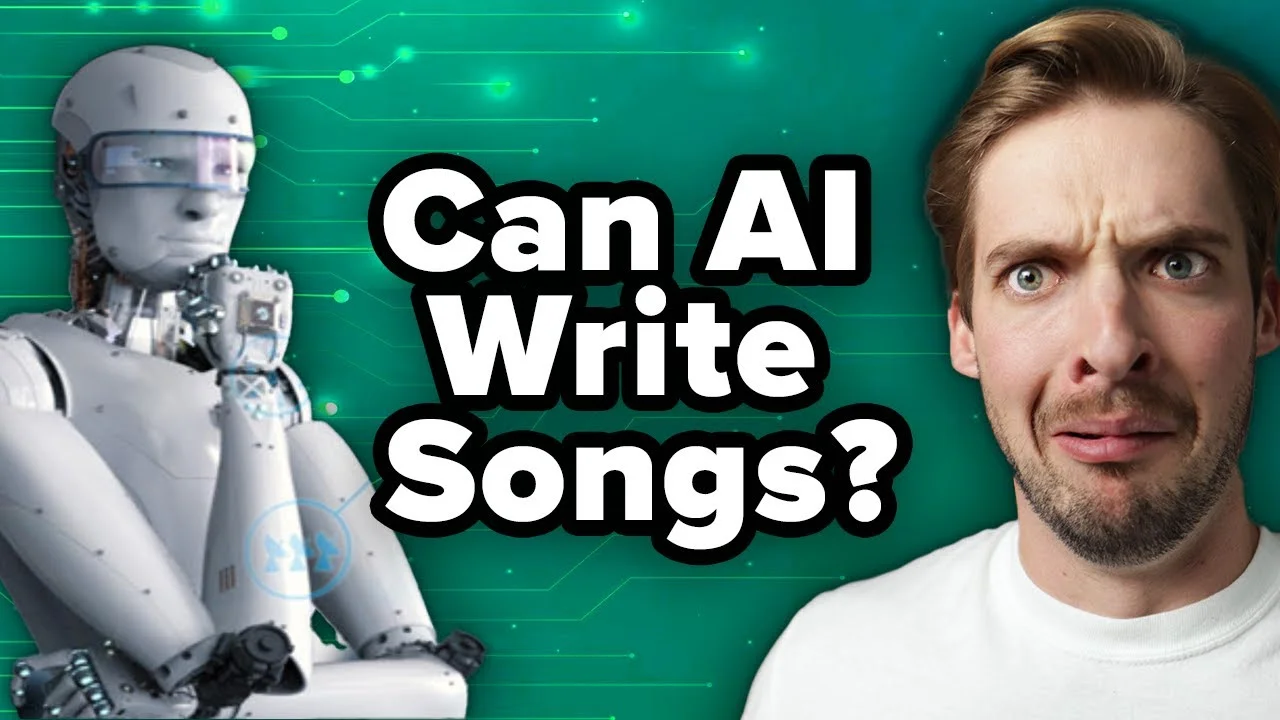
The 7 Best AI Songwriting Tools for Enhancing Your Songs!
Can AI actually write great songs? AI is advancing quickly, and in this video, I'll be showing you the 7 best AI songwriting tools that will take your music to

Key Takeaways
- AI songwriting tools work best as creative brainstorming partners, not complete song replacements.
- You still need good taste and songwriting fundamentals to pick winners from mediocre AI suggestions.
- Rytr, Jasper, and Notion consistently produce commercial-quality lyrics worth using in real projects.
- Current AI tools only handle lyrics—you'll still need human creativity for melodies and arrangements.
- Start with free trials from Notion and Rytr before investing in paid songwriting tools.
AI songwriting tools are everywhere these days — but can they actually write good songs, or are they just expensive toys for procrastinating musicians?
I spent weeks testing 7 of the top AI songwriting tools to find out. Some blew me away with their quality. Others… well, let’s just say I wouldn’t use them to write a grocery list.
As someone who’s written over a thousand songs professionally, I know what works and what doesn’t. I tested each tool with real client projects to see if they could handle the pressure of commercial songwriting.
Spoiler alert: three of these tools genuinely impressed me. One became my go-to for inspiration when I’m stuck.
I also made a full video on this…
All the ideas in this article come from the video below. If you don't feel like reading, well, I gotchu.
Part of the Songwriting series — For the full picture, read my complete songwriting guide.
What I Was Looking For
Before diving into the tools, I set some ground rules for my testing:
- Real-world application — could I actually use these lyrics for clients?
- Speed and efficiency — no point if it takes longer than writing myself
- Quality output — proper rhyme schemes, syllable counts, and song structure
- Usability — if the interface sucks, I won’t use it
I tested each tool with various inputs: different genres, moods, and complexity levels. Then I rated them on a 1-10 scale based on output quality and usability.
Tool #1: LyricLab — The Rhyming Dictionary on Steroids
Rating: 6/10
LyricLab markets itself as an all-in-one songwriting companion. It combines rhyming dictionaries, thesauruses, and AI-powered lyric suggestions into one interface.
The rhyming dictionary feature actually works well. It’s fast and gives solid suggestions that I’d use in real songs. The thesaurus? Not so much — pretty basic stuff you could get from any dictionary app.
But here’s where LyricLab falls apart: the lyric suggestions are hit or miss. I’d often spend 5-10 minutes cycling through suggestions before finding anything usable. That’s not a workflow I want to rely on.

The app costs $3/month with a free trial (I think it’s one month free). For beginners, this might be worth it as a learning tool. But if you’re already experienced with songwriting, you’ll probably find it frustrating.
Bottom line: This is a supplementary tool, not an AI songwriter. You still need good taste to pick out the rare gems from mostly mediocre suggestions.
Tool #2: These Lyrics Do Not Exist — The Wild Card
Rating: 7.4/10
This one’s completely free, which immediately gets points from me.
You input a feeling and genre, and it spits out an entire song in seconds. Pretty wild. There’s even an emoji input feature that gave me some surprisingly creative results.
The good: instant full songs that you can cherry-pick lines from. When it hits, it really hits with some genuinely usable lyrics.
The bad: inconsistent song structure. Not all syllables match up, some “rhymes” don’t actually rhyme, and the overall flow can be choppy.
I found the best approach was treating this like a brainstorming tool. Generate a few songs, grab the lines that spark something, and build from there.
For a free tool, this exceeded my expectations. If you’re stuck or need creative inspiration, it’s worth bookmarking.
Tool #3: Rytr — The Serious Contender
Rating: 9.2/10
Now we’re talking.
Rytr uses GPT-3 (same tech as ChatGPT) and has a specific “song lyrics” use case. You type in a basic song idea, and it generates structured verses and choruses.
The results floored me. Check out this line it wrote: “With my head in the clouds and my feet on the ground.”
That’s genuinely poetic and something I’d expect to hear in a modern commercial song. The metaphors are solid, the rhyme schemes work, and the syllable counts are consistent.
Rytr automatically structures songs properly with clear verses and choruses. Minimal input, maximum output — exactly what I want from an AI tool.
The pricing is reasonable too: free plan with 10,000 credits to start, then premium plans if you need more.
If you want an AI that can actually write complete songs, this is the closest thing I found that delivers consistently.
Tool #4: lyrics.mathigati.com — The Diamond in the Rough
Rating: 5.4/10
This one looks like it was built by a couple developers in their spare time — the UI definitely needs work.
But here’s the thing: buried in mostly mediocre output were some genuine gems.
You input a keyword, set creativity level, and wait (sometimes up to a minute) for results. Most generations aren’t great, but when you hit something good, it’s really good.
Since it’s completely free, it’s worth trying when you need inspiration. Just don’t expect consistency.
The name is terrible though. Seriously needs a rebrand.
Tool #5: Moises — The LyricLab Clone
Rating: 6.0/10
Moises feels almost identical to LyricLab. Rhyming dictionary, thesaurus, phrase suggestions — the whole package.
I actually couldn’t decide which was better between this and LyricLab. They’re that similar.
What I liked: The thesaurus includes antonyms (super useful for songwriting), and it shows syllable counts on the left side.
What frustrated me: Phrase suggestions often didn’t rhyme or make sense contextually. The rhyming dictionary is okay but I’d still supplement it with RhymeZone.
Like LyricLab, this is best for inspiration and organization rather than actual AI songwriting. You’re still doing the heavy lifting.
Tool #6: Jasper AI — The Powerhouse
Rating: 8.2/10
Jasper isn’t known for songwriting, but it’s incredibly powerful for content creation. Ask it to write a song, and you’ll get impressive results.
The interface can be finicky — sometimes it forgets to finish songs unless you click certain buttons. Unlike Rytr, there’s no dedicated song generation feature.
But when you get the inputs right, Jasper delivers commercial-quality lyrics. I found results I’d absolutely use for client projects.
They offer a 10,000 credit free trial. My advice? Try both Jasper and Rytr during their free trials and see which workflow clicks for you.
Tool #7: Notion — My Personal Favorite
Rating: 9.2/10
Plot twist: my favorite AI songwriting tool isn’t even marketed as one.
Notion’s AI can write songs, and the results consistently impressed me. It tied with Rytr for quality, but Notion’s speed gives it the edge.
The key is specific inputs. Instead of “write a song about love,” try “write a song about lost love that relates to ocean waves.” The more specific, the better the output.
Check out this chorus Notion wrote for me:
“Summer breeze blowing through our hair
We’ll dance and sing without a care
The days are long but the nights are live
Summer love will thrive”
Sure, it’s a bit corny, but the syllable structure is perfect, the rhyme scheme works, and it follows commercial songwriting conventions.
Notion is lightning fast — click enter and get instant results. Plus, if you already use Notion for other projects, the AI features are included.
Start with Notion’s free plan and see how it works for your songwriting process.
The Reality Check: AI Won’t Fix Bad Songwriting
Here’s what I learned after testing all these tools:
AI songwriting tools are supplements, not replacements. They won’t fix poor taste or fundamental songwriting skills. You still need to know what makes a good song.
The most successful approach I found was using AI for inspiration and starting points, then applying my experience to refine and polish the results.
Think of these tools like having a really fast collaborator who throws out ideas. Some are gold, some are garbage — you need the taste to tell the difference.
My Top Recommendations
If you’re just getting started with AI songwriting:
- Try Notion first — free plan, great results, super fast
- Test Rytr’s free trial — specifically built for songwriting
- Add Jasper to the mix — use their free credits to compare
For supplementary tools (rhyming dictionaries, organization):
- LyricLab or Moises — both around $3/month, good for beginners
For free inspiration when you’re stuck:
- These Lyrics Do Not Exist — completely free, good for brainstorming
What’s Missing: Melodies
The biggest gap I noticed? None of these tools help with melodies.
AI can write decent lyrics, but putting those words to memorable melodies still requires human creativity and musical knowledge. The rhythm, phrasing, and emotional delivery — that’s where the magic happens.

If you’re struggling with melody writing, that’s still a skill you’ll need to develop separately from these AI tools.
The Bottom Line
AI songwriting tools have genuinely impressed me. Rytr, Jasper, and Notion can generate commercial-quality lyrics that I’d use for real projects.
But they’re not magic. You still need taste, experience, and songwriting fundamentals to make the most of them.
The future looks promising though. If AI continues improving at this rate, we might see tools that can handle melodies, chord progressions, and full song arrangements.
For now, treat these as powerful brainstorming partners rather than replacement songwriters. Used correctly, they can definitely speed up your process and push you in creative directions you might not have explored otherwise.
The technology is here. The question is: are you ready to use it?
Want the full walkthrough? My course Pro Vocals in 60 Minutes takes you from raw recording to polished vocal, step by step.
About Mattie
Mattie is a music producer, songwriter, and educator specializing in Logic Pro and vocal production. With over 10 years of experience in the music industry, he's helped thousands of artists transform their home studio recordings into professional-quality tracks.
As the founder of Music By Mattie, he creates tutorials, presets, and courses that simplify complex production techniques. His mission is to make professional music production accessible to everyone, regardless of budget or experience level.