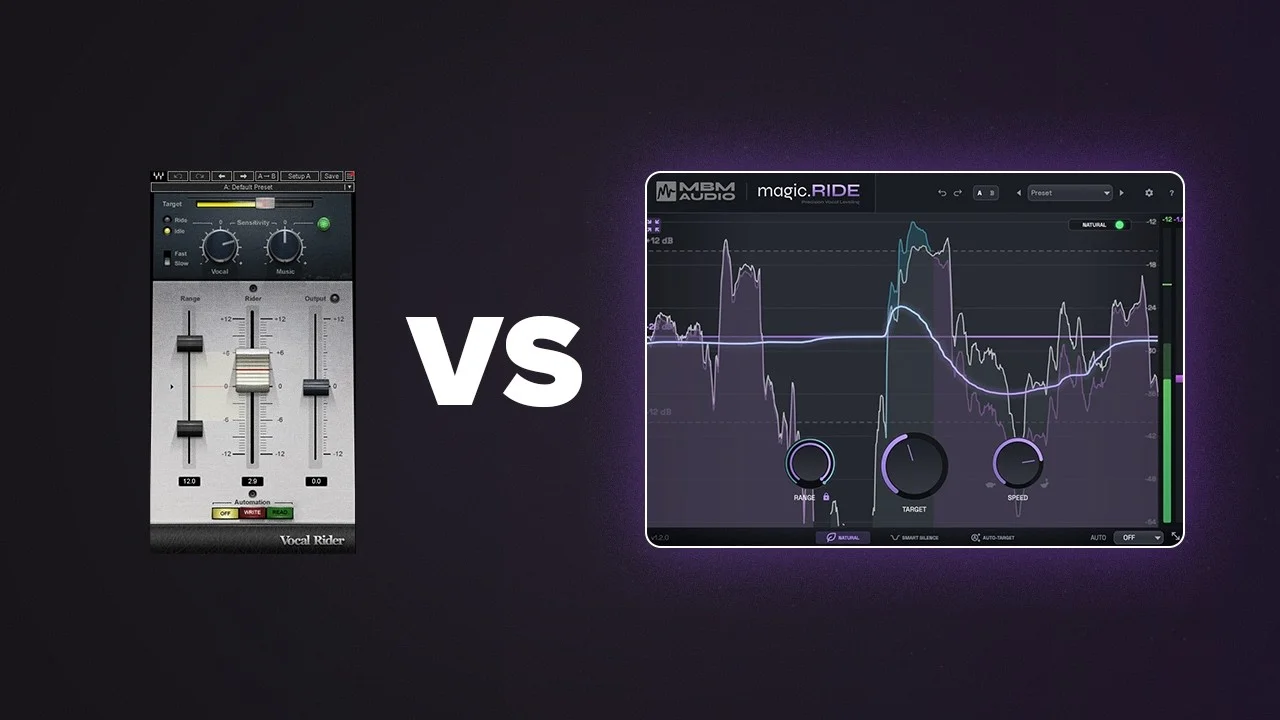
Waves Vocal Rider vs. My Custom Plugin (Blind Audio Test)
Can a custom-built plugin beat an industry standard? In today's video, we are doing a blind audio shootout comparing the legendary Waves Vocal Rider against my

Key Takeaways
- Test plugins blind to avoid bias when making mixing decisions
- LUFS detection offers more natural vocal riding than RMS algorithms
- Advanced controls let you customize vocal riding for each specific voice
- Natural phrase-based processing sounds more organic than syllable-by-syllable riding
I built my own vocal rider plugin because I couldn’t stand the ones that already exist.
The industry standard — Waves Vocal Rider — has been around forever, but it’s got some serious limitations that drive me crazy. So I decided to do something about it and create my own: magic.RIDE.
But here’s the thing — I’m not just going to tell you mine is better. That would be way too easy.
I also made a full video on this…
All the ideas in this article come from the video below. If you don't feel like reading, well, I gotchu.
Instead, I put both plugins through a blind audio test to see which one actually performs better. If Waves wins, I’ll shut up about my plugin. If mine wins… well, then I’m not an idiot.
The Blind Test Setup
To really put these plugins through their paces, I recorded three different scenarios that typically give vocal riders trouble.
I kept this test completely blind — I’m not telling you which plugin is which until the very end. So keep track in your head as we go through each round.
Round 1: High Dynamic Variation
First up: a vocal with massive dynamic range. That’s just fancy audio nerd speak for “big difference between the quietest and loudest parts.”
Here’s what I recorded, completely dry — just straight into my TLM 103 with zero processing:
“Quiet so the vocal gets lost, but now it’s too loud and the fader just dropped.”
You can hear the problem immediately. The quiet parts disappear, and the loud parts are way too aggressive.
Now here’s the same vocal with Plugin A:
[Processed version A plays]
And here’s Plugin B:
[Processed version B plays]
Which one sounded more natural to you? Which one handled those dynamic jumps better?
Round 2: Transients and Fast Syllables
Vocal riders typically struggle with transients and fast-moving syllables. So for round two, I recorded some rap vocals to really test this weakness.
Here’s the dry version:
“Closest in peace popping out of the pocket. The rider react but it’s moving too choppy. It squashes the syllables, sounds too sloppy.”
Notice all those quick consonants and rapid-fire syllables? That’s exactly where most vocal riders fall apart.
Plugin A version:
[Processed version A plays]
Plugin B version:
[Processed version B plays]
Did you notice how differently each plugin handled those quick transients?
Round 3: In the Full Mix
Here’s the most important test — how the vocal sits in a full mix.
It doesn’t matter what these vocals sound like isolated. What matters is how they work with drums, bass, synths, and everything else fighting for space.
For this round, I used a real track. I recorded my vocal to the entire mix and added some reverb, delay, and autotune — but no other processing besides the vocal riders.
[Full mix example with Plugin A]
[Full mix example with Plugin B]
This is where you really hear the difference in how each plugin approaches vocal level management.
The Big Reveal
Time to lock in your answers before I reveal which is which.
Seriously — go to the comments right now and type in your guesses. Don’t just lie to yourself later and claim you “knew it the whole time.” Prove it.
Ready for the results?
Plugin A was Waves Vocal Rider.
Plugin B was magic.RIDE — the plugin I built to replace Vocal Rider.
For all three rounds, Plugin A was always Waves, and Plugin B was always magic.RIDE.
What did you think? To me, magic.RIDE takes the cake in every single test.
And I guess that means I’m not an idiot after all.
Why magic.RIDE Actually Sounds Better
magic.RIDE outperformed Waves for several key reasons that go way beyond just “it’s newer.”
Way More Control Options
Waves Vocal Rider gives you the basics: target, range, and a few simple controls. That’s it.
magic.RIDE gives you a ridiculous amount of control so you can dial it in for every type of vocal. Click on the gear icon and you’ll see advanced settings for:
- Attack, release, and hold — with way more precision than Waves
- Breath deletion — automatically handles breathing sounds
- Transient detection — better handling of quick consonants
- Noise floor controls — deals with room noise intelligently
These are all settings that Waves Vocal Rider simply doesn’t have. And having them means you can customize the plugin for each specific vocal you’re working with.
Natural Phrase-Based Processing
One of the coolest features is the Natural mode. This automatically identifies vocal phrases and turns them down by phrase instead of by syllable.
Think about it — when a real engineer rides a vocal, they’re not constantly moving the fader on every single syllable. They’re thinking in musical phrases.
When you enable Natural mode, you can see it turn off when each phrase ends. This creates way more natural-sounding vocal rides and was a big reason why magic.RIDE sounded better in our blind test.
LUFS vs RMS Detection
Here’s the technical difference that makes a huge impact: detection algorithms.
Waves Vocal Rider only uses RMS (Root Mean Square) to detect loudness. That’s it — no options, no alternatives.
magic.RIDE gives you both RMS and LUFS detection algorithms.
If you’re new to audio, here’s what you need to know: RMS and LUFS are different ways of measuring loudness. LUFS is more natural and accurate — it’s actually what mastering engineers use to measure loudness in professional settings.
LUFS works over a longer time period and gives you more musical results. The fact that you can choose between them means you can pick the right algorithm for each specific vocal.
Actually Modern Interface
Let’s be honest — Waves Vocal Rider looks like it’s from 2005. Because it basically is.
magic.RIDE has a modern GUI that actually makes sense. You can see what’s happening, the controls are intuitive, and you don’t feel like you’re using software from the stone age.
But it’s not just about looks — the interface actually helps you work faster and make better decisions.
Try magic.RIDE for Free
Look, you don’t have to take my word for any of this.
I believe in this plugin so much that I made a free version — magic.RIDE lite.
It doesn’t have all the features of the full version, but you’ll get a real feel for what the algorithms sound like on your voice. You won’t have access to:
- Advanced settings
- Automation writing
- Speed controls
- Gain amount controls
But you will get:
- Natural mode — phrase-based processing
- Auto-target mode — automatic level detection
- Target mode options — different detection methods
- Smart silence — intelligent silence detection
It’s completely free, so there’s no reason not to try it.
I still had to make the paid version worth the upgrade — and I think it absolutely is. But for anyone who wants to test it out or isn’t sure yet, you can download magic.RIDE lite right from my website.
The Bottom Line
Building magic.RIDE wasn’t just about creating “another vocal rider plugin.” It was about solving the specific problems that drive me crazy with existing options.
Waves Vocal Rider has been the industry standard for years, but that doesn’t mean it’s perfect. It’s limited, outdated, and often sounds robotic.
magic.RIDE gives you the control, algorithms, and natural processing that actually match how professional engineers work.
The blind test results speak for themselves — but more importantly, you can try it yourself and hear the difference on your own vocals.
Download the free version and see what you think. Your vocals will thank you.
Want a professional starting point? My Vocal Magic presets give you ready-made vocal chains for any genre — EQ, compression, reverb, and more, all dialed in and ready to go.
Or grab my free vocal presets to try before you buy.
About Mattie
Mattie is a music producer, songwriter, and educator specializing in Logic Pro and vocal production. With over 10 years of experience in the music industry, he's helped thousands of artists transform their home studio recordings into professional-quality tracks.
As the founder of Music By Mattie, he creates tutorials, presets, and courses that simplify complex production techniques. His mission is to make professional music production accessible to everyone, regardless of budget or experience level.