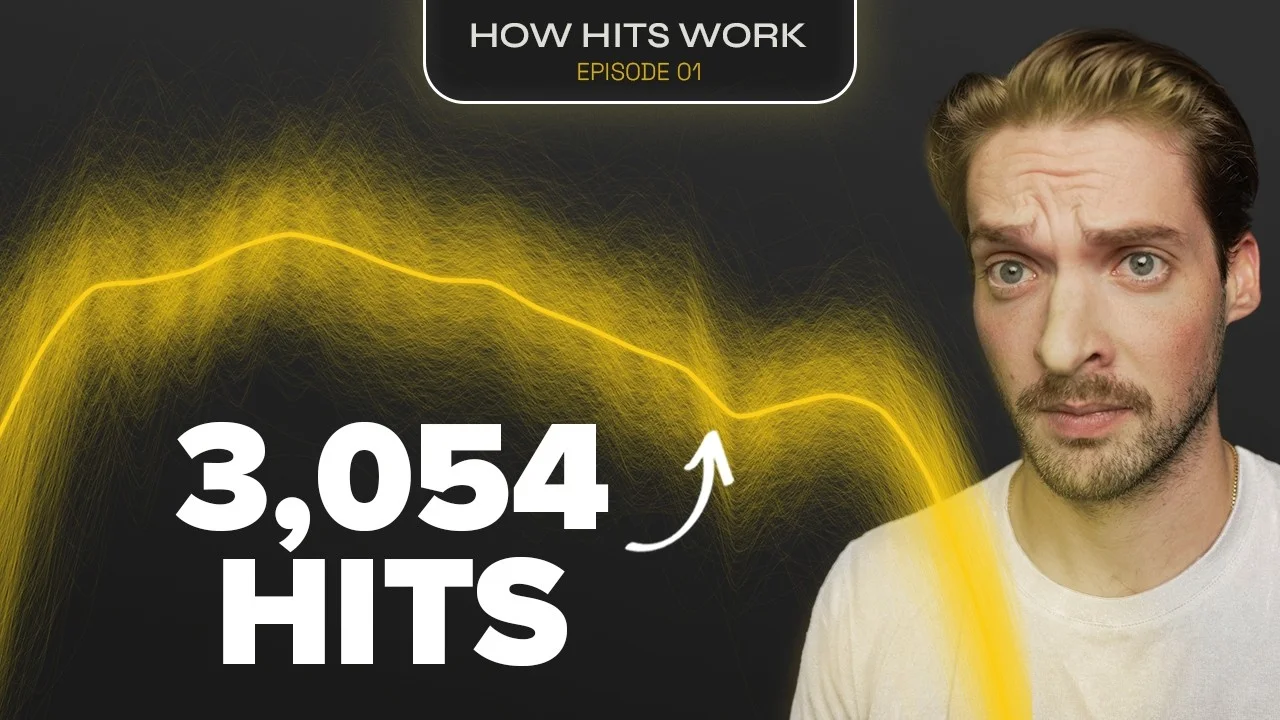
I Analyzed 3,054 Hit Vocals to Find the Perfect EQ Curve
I analyzed the vocals of 3,054 Billboard hit songs from 1990 to 2025 to see if they shared a similar EQ pattern. Spoiler: they do.

Key Takeaways
- 3,054 hit songs across 35 years follow a remarkably similar vocal EQ curve - intelligibility over warmth, with a clear ~5 kHz dip and modern high-end air.
- The 5 kHz dip isn't a mixing trick - it's anatomy. The human voice naturally has less energy there.
- Genre changes everything: pop is bright and forward, hip hop is warm and sibilant, country is darkest, electronic is brightest.
- Don't worship the curve. Artists like Billie Eilish break it on purpose - know why before you deviate.
- If your raw vocal is more than 12 dB off the curve, re-record. EQ should refine, not rebuild.
I analyzed the vocals of 3,054 Billboard hit songs from 1990 to 2025 to see if they share a common EQ pattern.
Spoiler: they do. And it’s almost identical across genres, decades, and singers.
In this post I’ll show you the curve, walk you through what each zone is doing, explain why one weird dip in the middle has nothing to do with mixing technique, and tell you when to break the rule on purpose.
I also made a full video on this…
All the ideas in this article come from the video below. If you don't feel like reading, well, I gotchu.
How the dataset came together
Before getting into the curve, here’s how I built it.
- I wrote a script that pulled every Billboard hit since 1990
- Used that list to scrape and download each track from YouTube
- Ran every track through DMX version 4 (a stem separator) to isolate the vocals
- Analyzed the frequency response of each isolated vocal
- Plotted all 3,054 of them on the same chart, then averaged them with 25th and 75th percentile bands
That’s the whole methodology. No cherry-picking, no genre filtering at the source level. Every Billboard hit from 35 years got the same treatment.
The curve, revealed
The first thing that jumped out: how similar the average is for almost every vocal in the dataset.
Different decades. Different genres. Different producers. Different singers. The average vocal curve barely moves.
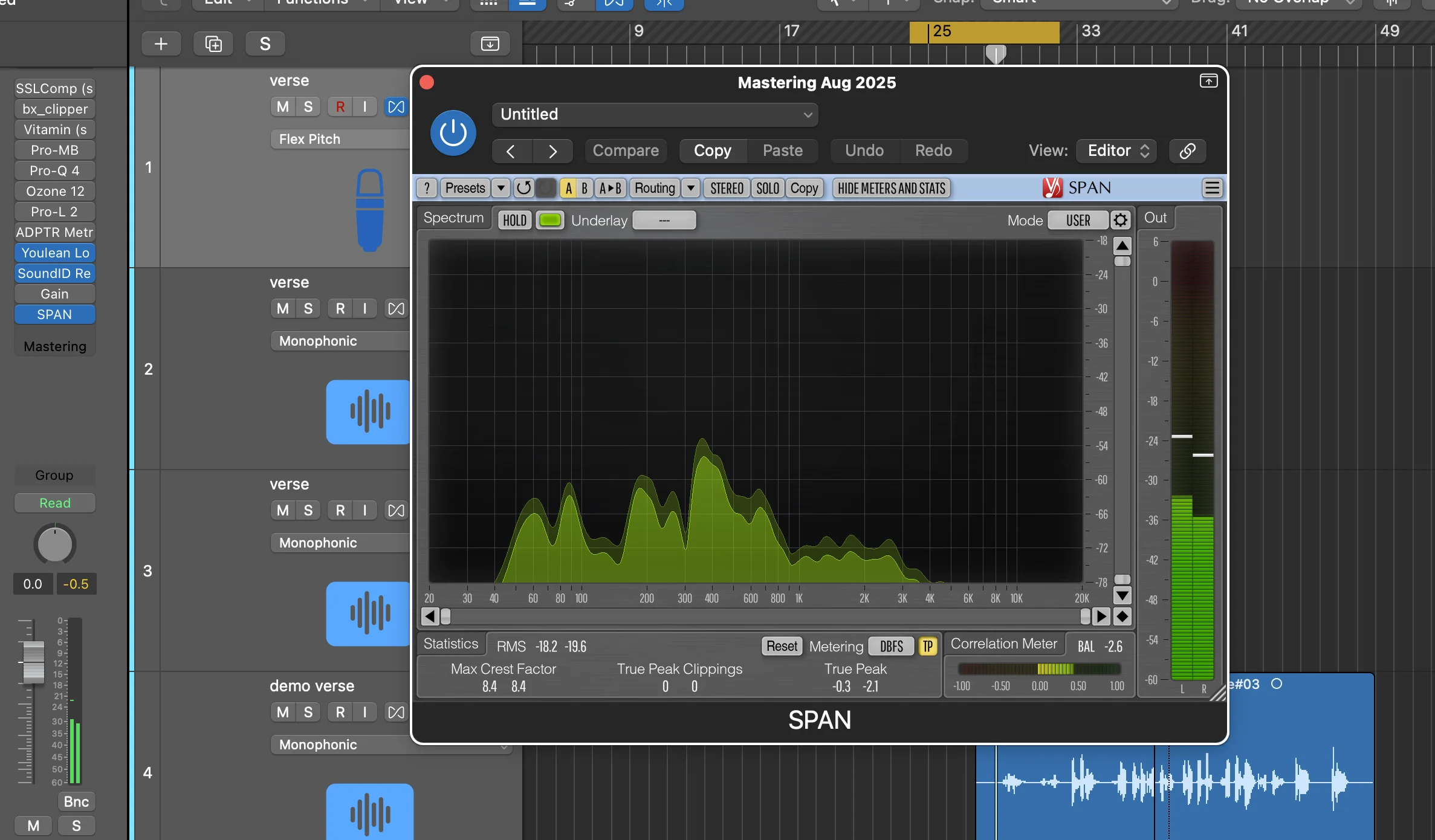
Four songs that landed almost on top of each other:
- Spice Girls - “Wannabe” (1996)
- Eminem - “Lose Yourself” (2002)
- Daddy Yankee, Justin Bieber, Luis Fonsi - “Despacito” (2017)
- Hozier - “Too Sweet” (2024)
Twenty-eight years apart. The vocal frequency shapes look nearly identical.
When you filter pink noise through the average curve, you hear the collective shape of 3,054 hit vocals. It’s recognizable as a vocal. It’s recognizable as a hit-shaped vocal.
Zone-by-zone: what each part of the curve is doing
The curve has five distinct zones. Each one tells a different story about how producers are treating vocals on a hit.
Below 125 Hz - basically nothing
The lowest octaves are mostly empty. There’s some sub-frequency content, but it’s not load-bearing for vocals.
Most engineers high-pass aggressively here. You’re not losing anything by cutting it.
200-500 Hz - the body, used carefully
This is where the body of a voice lives. Push it too hard and you get mud.
Here’s the interesting part: across 3,054 hits, this region has less energy than 500 Hz to 1 kHz. Producers are consciously prioritizing intelligibility (the upper-mid range) over warmth (the lower-mid range).
That’s a counter-intuitive finding. The “warmth” everyone talks about? It’s pulled back. The clarity is what wins.
500 Hz to 1 kHz - intelligibility
This is where the words live. Cut too much here and you can’t understand the lyrics.
Hits don’t cut this region. They feature it.
1 kHz to 3 kHz - core forwardness
This is what makes a vocal feel forward in the mix. The “in your face” zone.
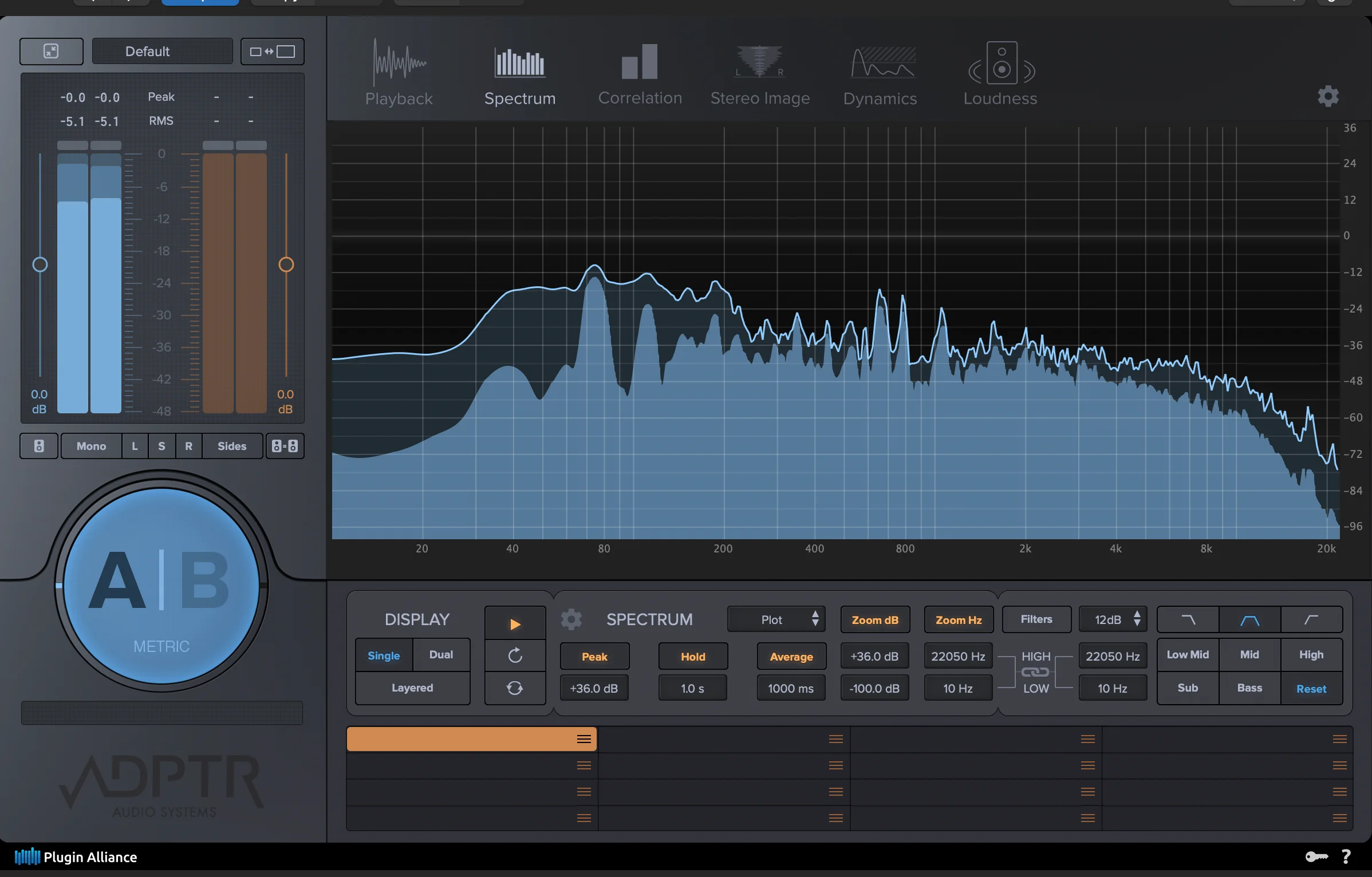
If your vocal feels distant, this is usually where it’s lacking. If it feels too aggressive, this is where it’s too hot.
A strange dip around 5 kHz
This is the most interesting finding in the whole study.
Almost every hit vocal has a small dip around 5 kHz. Garth Brooks, Plum, Don Omar - three random pulls, all have it.
Why? It’s not a mixing trick.
It’s anatomy. The human voice physically has a harder time generating frequencies in that exact range. The dip exists in the recording before any engineer touches it. It just shows up in the average because it shows up in everyone.
High end - the modern shimmer
There’s a clear boost in the presence and air above 8 kHz, especially in modern tracks.
Go back to the 60s and 70s and you don’t see this. Recording technology couldn’t capture it cleanly. Modern hi-fi systems can, and modern producers are using it heavily.
That airy “shimmer” on top of pop vocals? It’s not a hardware thing. It’s the EQ choice that defines modern vocal production.
Genre changes the curve
If you break the dataset down by genre, the curve shifts in predictable ways:
- Pop - the most present genre in the entire dataset. Forward upper-mids, very bright, heavy air above 8 kHz.
- Hip hop - warmer and rounder in the low end, more sibilant up top
- Country - warmest and darkest of all. Less high end, more vintage/smooth feel.
- Electronic - the brightest genre. The highest spectral tilt of anything tested.
A lot of this is intuitive. You’d expect country to be warmer than EDM, and you’d be right. The cool part is having actual data to back it up across thousands of tracks.
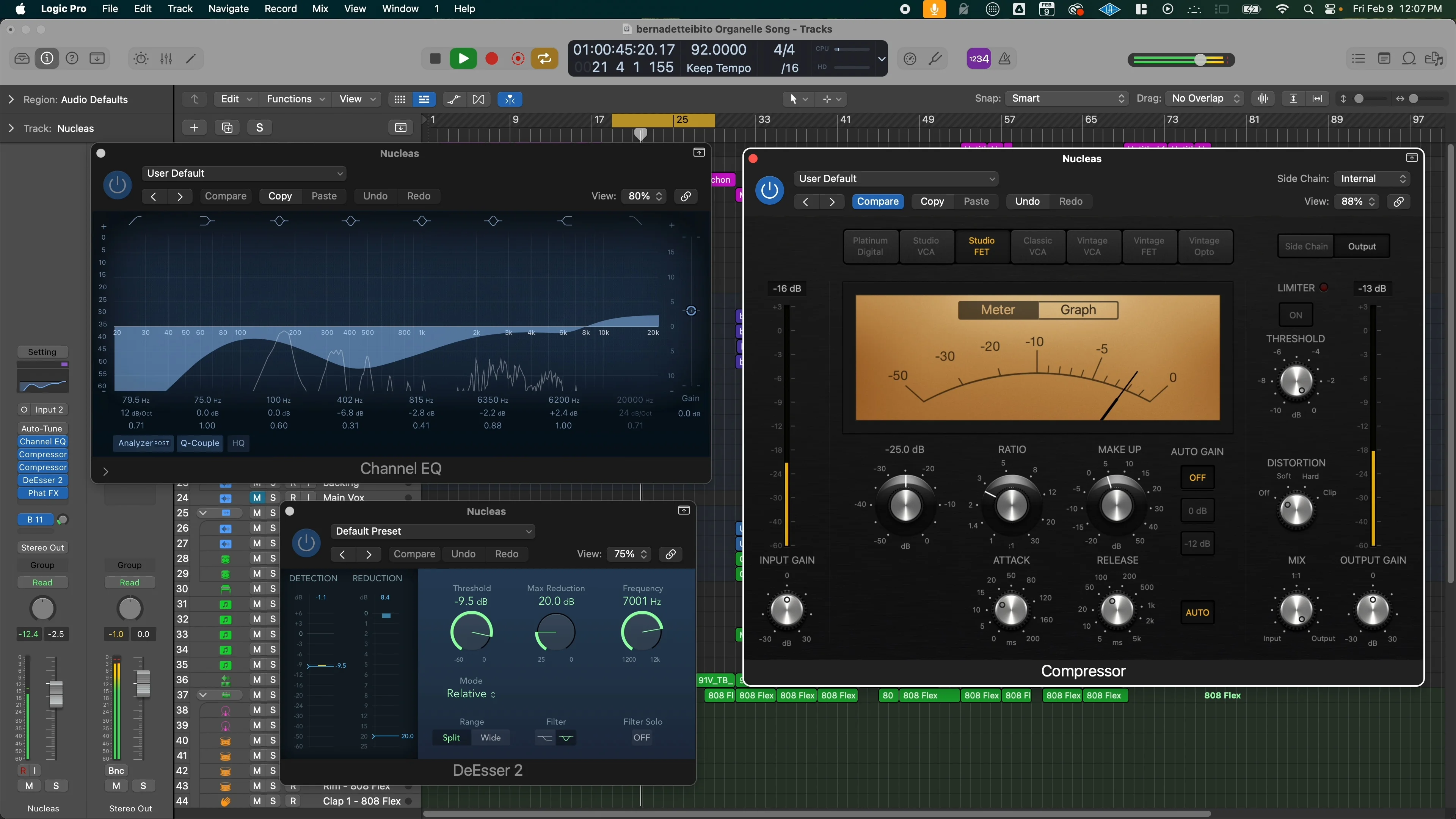
If you’re mixing in a specific genre, the right “perfect curve” isn’t the global average. It’s the genre-specific one.
When to break the curve
Not every hit follows the average.
Billie Eilish is a perfect example. Her vocal curve is significantly warmer and less bright than the average. By a wide margin.
That’s not a mixing failure. It’s a deliberate choice. She has a whispery, intimate voice and sings right up on the mic. The vocal is quiet, close, and dark on purpose - and it’s part of why she’s successful.
The takeaway: the curve is a really good guide for the majority of music. Following what 3,054 hits are doing is almost always a safer bet than going against it. But if you do break the rules, do it on purpose, not because you don’t know how to get your vocal close to the curve in the first place.
How to actually use this on your own vocals
Don’t open Logic and start adding 12 dB of 8 kHz to your vocal because of one chart. That way leads to ear-shredding mixes.

Here’s the real workflow:
- Compare your raw vocal to the curve first. If it’s already vaguely in the right shape, EQ becomes refinement, not rescue.
- If your raw vocal is more than 12 dB off the curve in any region, re-record. Different mic, treated room, better technique. EQ can do a lot, but it can’t fix a fundamentally bad capture.
- Use a match EQ as a reference, not a target. I tested Logic’s match EQ against the curve - it got close but the result felt strange. Match EQs are good for diagnosing the gap, not for being the final EQ.
- Apply broad strokes, not surgical ones. The hits aren’t doing tight 1 dB notches everywhere. They’re doing wide, musical curves.
Compare your own vocal to the dataset
I built a free tool called the Vocal Analyzer that does this exact comparison for you. You upload a vocal, pick the genre, and it scores you against the curve from this dataset.
I tested it on Adele’s “Rolling in the Deep” - it scored an 84. The breakdown said her vocal was a touch under on high end compared to her own artist average, which is probably why she got docked. (Adele in real life is probably a 105 out of 100, but the algorithm doesn’t care about feels.)
I also tested a raw vocal I recorded myself. Got an 83. The tool said it was lacking clarity. I ran it through some EQ and compression based on the recommendations and brought it up to an 85. Small jump, but a real one.
If you want a vocal chain that’s already shaped close to the hit curve out of the box, my Vocal Magic presets are built around this kind of analysis. Saves you the trial-and-error of getting from “raw vocal” to “in-the-pocket vocal”.
What’s next
EQ is only one piece of what makes a vocal sound like a hit.
I’ve got more analysis from this dataset coming - dynamics, stereo width, vocal volume relative to the mix, and the one I’m most excited about: the differences between a #1 hit and a #40 hit.
When I ran that last comparison, one thing stood out more than anything else. And it wasn’t EQ. It wasn’t mixing technique either. I’ll cover what it is in the next post.
Want a professional starting point? My Vocal Magic presets give you ready-made vocal chains for any genre — EQ, compression, reverb, and more, all dialed in and ready to go.
Or grab my free vocal presets to try before you buy.
About Mattie
Mattie is a music producer, songwriter, and educator specializing in Logic Pro and vocal production. With over 10 years of experience in the music industry, he's helped thousands of artists transform their home studio recordings into professional-quality tracks.
As the founder of Music By Mattie, he creates tutorials, presets, and courses that simplify complex production techniques. His mission is to make professional music production accessible to everyone, regardless of budget or experience level.