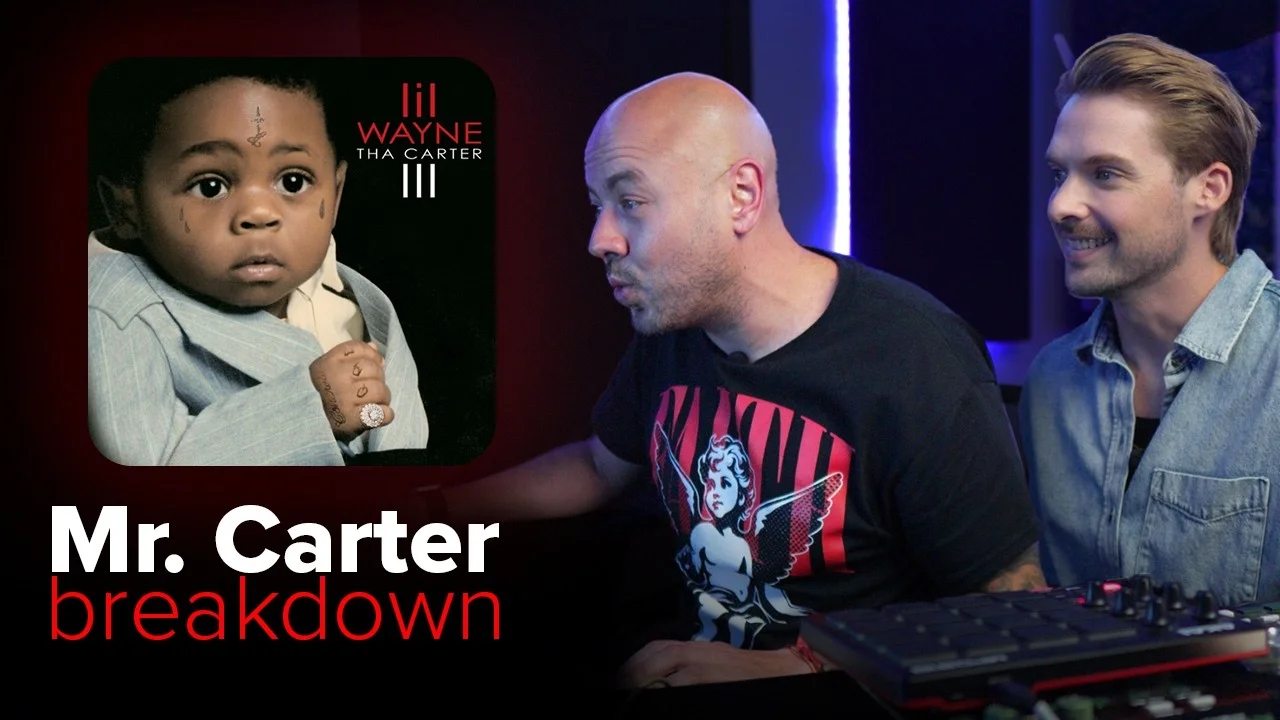
The Producer behind Lil Wayne and Jay-Z Breaks down his biggest beat
Meet Drew Correa. The producer behind the grammy winning song Mr. Carter by Lil Wayne ft. Jay-Z. Here's a deeper dive into how he made the song, the chains he u
Key Takeaways
- Record vocals slower then speed up for vintage pitch-shifted sound
- Layer multiple kicks for punch and low-end fullness
- Use MPC filters to add authentic sampled texture
- Simple arrangements often work better than complex ones
- Build crowd effects with friends for authentic energy
Ever wondered what goes into making a Grammy-winning hit that features two of hip-hop’s biggest legends?
I sat down with Drew Correa — the mastermind behind “Mr. Carter” by Lil Wayne featuring Jay-Z — to break down everything from how he tricked Wayne into thinking it was a sample to the wild story of how Jay-Z ended up on the track.
This isn’t just another producer interview. Drew pulled up the actual Pro Tools session and walked me through every element that made this song a classic.
I also made a full video on this…
All the ideas in this article come from the video below. If you don't feel like reading, well, I gotchu.
From Intern to Young Money’s Secret Weapon
Drew’s journey started like so many producers — messing around with beats at 16. But his real break came through the most unexpected route.
After graduating from Full Sail, he landed an internship at Studio Center in Miami. He worked his way up to become Trina’s engineer, which seemed like a solid gig.
But then Trina started dating Lil Wayne.
“Wayne didn’t have a place to record when he came out to Miami,” Drew explains. “This was in 2005. Trina’s people somehow got him in contact with me and we had our first session together.”
It wasn’t exactly a glamorous introduction — Wayne couldn’t find a studio, so they went to Drew as a last resort.
But Wayne kept coming back.
“Until one day he’s like, ‘Hey man, you know, come with me now, you’re Young Money.’ He took me from the studio and away from Trina also.”
Working with Someone Who Never Writes
Here’s something that’ll blow your mind — Wayne doesn’t write lyrics.
Not even a little bit.
“He doesn’t write at all,” Drew confirms. “A lot of people think that he’s freestyling, but it’s not freestyling. He’s just — he has a good memory.”
Wayne’s process is pure mental gymnastics. He hears the beat, creates verses in his head, and somehow remembers everything.
“Sometimes he’ll drop down four bars and keep listening to more, or sometimes he’ll just do the whole 16 in one take.”
Drew has seen Wayne with a notebook occasionally, but it’s never lyrics — “I think it’s like something for later or maybe it’s just his food order.”
The man’s entire catalog lives in his head. That’s not freestyling — that’s straight-up superhuman memory.
The Jay-Z Surprise Nobody Saw Coming
When Drew created “Mr. Carter,” Jay-Z wasn’t even on his radar.
Which is wild when you think about it — a song called “Mr. Carter” and it never crossed his mind that Carter is Jay-Z’s last name too.
“I played it for Wayne and then after he put his verse on it, I just haven’t heard about it in like 2-3 months,” Drew recalls.
Then came the New Year’s call that changed everything.
Mack Maine (Wayne’s right-hand man) casually dropped the bomb: “Oh, you know Jay-Z’s going to get on that record?”
Drew’s reaction? “What? No, no, no, no.”
He completely dismissed it. Too good to be true.
“I never really thought much of it and then eventually we got the call — Jay hopped on it and then I got a chance to hear a rough mix of it.”
Sometimes the biggest moments in your career happen when you’re not even paying attention.
The Sample That Wasn’t a Sample
Here’s where Drew pulled off one of the smoothest producer moves ever.
He told Wayne he’d found this “crazy sample” for the hook. Wayne was hyped.
But there was no sample.
“I had a friend come over — Shondrae Crawford. I had him record it down to the beat and had him record to the beat incredibly slow and then re-sped him back up.”
This was Drew’s old-school method for getting that classic pitched-up vocal sound. Record everything slow on the MPC, then speed it back up.
“I try to make it sound as much as a sample as I could, which it wasn’t.”
The kicker? “I’m not sure if he knows till this day if it is or it’s not. We’ve never spoken about it ever since.”
That hooky “Hey Mr. Carter” chorus that everyone thinks is a sample? Pure studio trickery from 2007.
The Dream That Became the Ending
The most epic part of “Mr. Carter” almost didn’t happen.
“I had some sort of dream about like a crowd and they were all singing Mr. Carter,” Drew remembers. “So that’s how I kind of came up with the name.”
But he didn’t stop at just the concept. He made that dream literal.
“I got the session back and I had all my friends from high school come in my apartment and we all started drinking and singing that at the end of the record.”
Every voice you hear in that massive crowd chant is Drew and his high school friends, probably slightly drunk, living their producer fantasy.
“I wanted to make it epic at the end and kind of like fulfill that dream or vision that I had in the beginning. And also I wanted to put my friends on it.”
That’s what separates good records from great ones — that extra energy you can feel through the speakers.
The Secret Kendrick Connection
Here’s a piece of “Mr. Carter” history most people don’t know about.
Wayne recorded multiple verses before landing on the final version. One of those scrapped verses? It found its way to Kendrick Lamar.
“Kendrick Lamar ended up releasing a version. He rapped over the Mr. Carter beat and then put in an unreleased verse of Lil Wayne. It’s called ‘Mr. Carter Part Two’ I think.”
Drew only found out about this a year ago. An unreleased Wayne verse, over his beat, with Kendrick adding his own bars.
“I thought that was crazy that he did a version of that record and put in a secret unreleased Lil Wayne verse.”
Breaking Down the Pro Tools Session
When Drew opened up the actual session, the workflow was fascinating — and completely insane by today’s standards.
The Vintage Workflow
“Mr. Carter” was sequenced on the MPC 2000. But here’s where it gets weird.
“The piano and the organs actually came from Kontakt. I was using MIDI to trigger my desktop and sequencing everything on the MPC and then re-recording it into the MPC and then re-dumping everything back into Pro Tools.”
Why this crazy roundabout method?
“I like putting it back into the MPC. It kind of does something to the samples and sounds when you put it back into it.”
The whole project was saved on Zip disks — remember those? 100 megabytes of storage. That’s smaller than most iPhone photos today.
The Drum Foundation
The drums are built on two different kicks.
“One has more low end to it and this one is more of a punch to it,” Drew explains.
This is classic producer technique — layer different elements to get fullness and punch simultaneously. One kick handles the sub frequencies, the other cuts through the mix.
Add in the snare, hi-hats, and live tambourines, and you’ve got the foundation.
“The trick is you want your stuff to sound good already. If it doesn’t sound good from the beginning, you might as well just change your sound up.”
The Secret Weapon Sound
Remember that vocal element that “tricked Wayne”? Drew found it in the Motif ES — just a single note in a drum kit that he chopped and flipped.
“This right here is my secret weapon. That’s what tricked Wayne.”
Combined with the MPC’s built-in filter, this became the sampled-sounding element that sold the whole illusion.
“When I put this in the MPC, I added the MPC 2000XL’s filter and filtered it through the MPC before I spit it back out. So that actually added to the more sampley sound.”
The Bass That Shouldn’t Work
Drew’s honest about his bass playing: “My bass was awful. Terrible.”
But then he brought in Infamous to lay down the real bass lines through a Line 6 amp.
“The bass sound by itself doesn’t sound that good in my opinion. But with everything together, it works really well.”
This is a crucial mixing lesson — elements don’t need to sound perfect in isolation if they serve the song.
Wayne’s Vocal Approach
Looking at Wayne’s vocal tracks reveals his unique recording style.
Wayne only uses one track. No ad-libs, no backgrounds, nothing — just multiple punches from different takes all on the same channel.
“There were like three different verses that he scrapped before the final version that came out. And he didn’t write down a single one.”
When Wayne doesn’t like something, he just starts over. No notes, no reference — pure instinct.
The version in Drew’s session? “No one’s heard this. This is the unheard verse. For context, this is the verse that Kendrick Lamar took and put in his version of Mr. Carter.”
Building the Epic Crowd
That massive crowd effect at the end took serious layering.
Drew started with an actual crowd sound effect, then built on top of it:
- His friend singing the harmony
- Multiple takes of his high school friends
- Pitch-shifted versions for texture
- Just the girls doing certain parts
- Hand claps layered throughout
“I pitch shifted the girls down. It was just to get as many layers of different textures in there.”
According to Drew’s calculations? “A lot” of layers.
But this is what creates that larger-than-life feeling that makes certain songs feel like anthems.
The Mix That Changed Everything
Drew was in the room when Fabian Marasciulo mixed the final version.
“It’s night and day. The mix sounds amazing.”
This highlights something crucial for producers — your beat needs to sound good, but a great mix engineer takes it to another level entirely.
The arrangement also evolved after Wayne’s vocals. Drew took the session back, rearranged elements, muted certain sections, and highlighted Wayne’s verses.
“After he recorded his part, I brought it back to my crib and then I rearranged the beat. I muted certain areas and I kind of highlighted certain parts of his verse.”
Wayne’s Hit-or-Miss Reality
Working with Wayne means playing the numbers game.
“With Wayne, you’re throwing darts and seeing which one sticks,” Drew explains.
How many beats actually make it onto albums? “Very little, man.”
Wayne records constantly — “He’ll record like hundreds of songs for one album and then choose like 16 songs or 20, whatever it is.”
That’s the reality of working with prolific artists. You might make a hundred beats for one placement.
But when you hit? You hit big.
The Takeaway for Producers
“Mr. Carter” wasn’t just luck — it was the result of understanding your artist, taking creative risks, and adding those extra touches that make songs memorable.
Drew didn’t just make a beat. He created a story, built an atmosphere, and even fulfilled a literal dream with his friends.
The technical elements matter — the dual kicks, the MPC filtering, the pitch-shifted vocals. But the magic happens when you combine technical skill with creative vision and authentic energy.
Sometimes the best “samples” are the ones you create yourself. Sometimes the best crowd is your drunk friends in your apartment. And sometimes the biggest hits come from the simplest ideas executed with obsessive attention to detail.
That’s how you make music that lasts.
Not sure what’s wrong with your vocal? Run it through my free Vocal Analyzer - it scores your vocal from 0 to 100 and gives you specific recommendations on what to fix first.
About Mattie
Mattie is a music producer, songwriter, and educator specializing in Logic Pro and vocal production. With over 10 years of experience in the music industry, he's helped thousands of artists transform their home studio recordings into professional-quality tracks.
As the founder of Music By Mattie, he creates tutorials, presets, and courses that simplify complex production techniques. His mission is to make professional music production accessible to everyone, regardless of budget or experience level.